
Introduction
If you’ve spent time on TikTok, Instagram, YouTube, or watched Arabic movies, you’ve probably heard the word Habibi. But what exactly does Habibi meaning refer to? Is it only used between couples, or can friends and family use it too? Understanding this popular Arabic word helps you appreciate its cultural significance and avoid using it incorrectly.
In this guide, you’ll learn the complete Habibi meaning, its Arabic origin, pronunciation, different contexts, masculine and feminine forms, and how native Arabic speakers use it in everyday conversations. We’ll also explore examples, cultural etiquette, and common misconceptions so you can confidently understand and use this beautiful expression.
Quick Facts About Habibi
| Feature | Details |
| Main Keyword | Habibi Meaning |
| Language | Arabic |
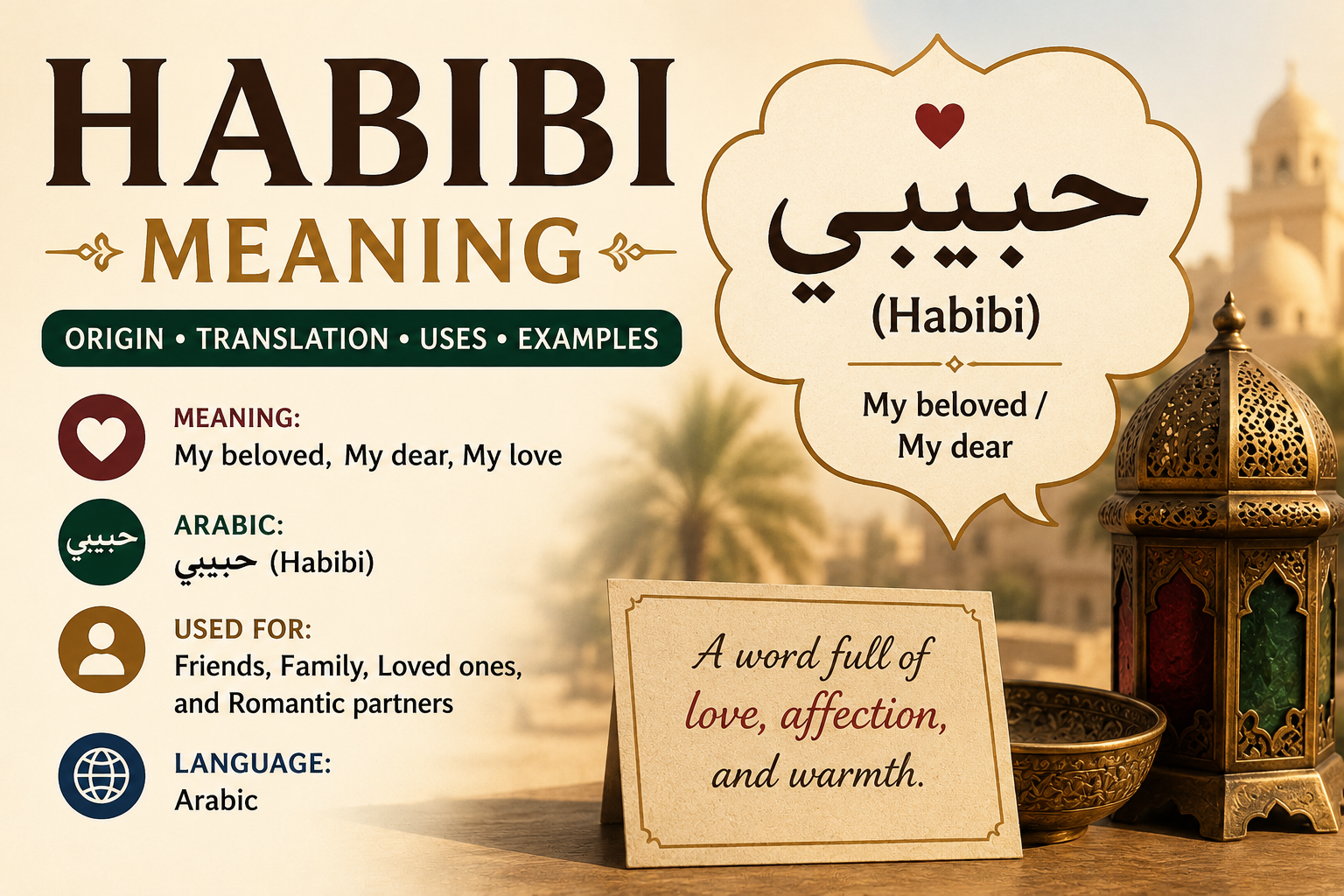
| Arabic Spelling | حبيبي |
| Literal Meaning | My beloved / My dear / My love |
| Feminine Form | Habibti (حبيبتي) |
| Common Usage | Friends, Family, Couples |
| Popular Regions | Middle East & North Africa |
| Tone | Affectionate, Friendly, Respectful |
What Does Habibi Mean?
The Habibi meaning comes from the Arabic word ḥabīb (حبيب), which means “beloved,” “dear,” or “loved one.” Adding the suffix “-i” changes the meaning to “my beloved” or “my dear.”
Unlike English phrases that are often reserved for romantic partners, Habibi has a much broader meaning. Native Arabic speakers frequently use it among close friends, siblings, parents, children, cousins, and even trusted colleagues. The exact meaning depends on the relationship and tone of the conversation.
Here are some common English translations of Habibi:
- My love
- My dear
- My beloved
- Darling
- Dear friend
- Sweetheart
- Buddy (in casual settings)
- My friend
- My favorite person
- Someone I care about
Although the literal translation is “my beloved,” the emotional meaning varies according to the situation. A parent calling a child Habibi expresses affection, while two close friends may use it as a warm greeting. Couples often use it romantically, making it one of the most versatile Arabic expressions.
Today, the Habibi meaning has become internationally recognized through Arabic music, social media, football culture, travel content, and influencers. Even people who don’t speak Arabic often recognize the word because of its frequent appearance in songs and viral videos.
Habibi Meaning in Arabic
To fully understand the Habibi meaning, it’s helpful to know its linguistic roots. The word comes from the Arabic root ḥ-b-b (حب), which relates to love, affection, and emotional attachment. Many Arabic words connected to love originate from this same root.
The Arabic spelling is:
حبيبي
It is commonly pronounced as:
Ha-bee-bee
Each part of the word contributes to its meaning:
- Habib (حبيب) = Beloved or dear person
- -i (ي) = My
Together, they form Habibi, meaning “my beloved” or “my dear.”
Arabic speakers use Habibi naturally in everyday conversations. You might hear someone say:
- Habibi, how are you?
- Thank you, Habibi.
- Come here, Habibi.
- Don’t worry, Habibi.
- Good morning, Habibi.
- See you tomorrow, Habibi.
- You’re welcome, Habibi.
- Congratulations, Habibi.
- Take care, Habibi.
- Have a safe trip, Habibi.
One reason the Habibi meaning is so popular is its warmth and flexibility. Unlike many affectionate words in other languages, it comfortably fits romantic relationships, close friendships, and family interactions without sounding unusual.
Its universal feeling of kindness and affection explains why the word has spread far beyond Arabic-speaking countries and become a recognizable expression worldwide.
Habibi Meaning in English
The most accurate Habibi meaning in English is “my beloved” or “my dear.” However, there isn’t a single English word that perfectly captures all the emotions behind the Arabic expression. Depending on the conversation, Habibi can mean “my love,” “dear friend,” “sweetheart,” “buddy,” or simply someone you deeply care about.
Unlike English, where words like “darling” or “sweetheart” are usually reserved for romantic partners, Arabic speakers use Habibi much more broadly. It’s common to hear parents call their children Habibi, siblings greet each other with the word, or close friends use it in casual conversations.
Here are some common English meanings of Habibi:
| Arabic Word | English Meaning | Common Usage |
| Habibi | My beloved | Romantic partner |
| Habibi | My dear | Friends |
| Habibi | My love | Husband or wife |
| Habibi | Darling | Family members |
| Habibi | Buddy | Close friends |
| Habibi | Dear one | Everyday conversation |
Here are examples of Habibi used in English-style conversations:
- Thank you, Habibi.
- Don’t worry, Habibi. Everything will be okay.
- Welcome home, Habibi.
- Good luck, Habibi.
- I missed you, Habibi.
- Have a wonderful day, Habibi.
- See you tomorrow, Habibi.
- You’re the best, Habibi.
- Come sit with us, Habibi.
- Drive safely, Habibi.
The popularity of the Habibi meaning has grown globally because people appreciate its warmth and friendliness. Today, you’ll hear it in music, sports interviews, travel videos, and social media content across many countries.
Habibi vs Habibti
One of the most common questions about Habibi meaning is the difference between Habibi and Habibti. Although both express affection, they are used for different genders.
The distinction is simple:
| Word | Arabic | Used For | Meaning |
| Habibi | حبيبي | Male | My beloved, my dear |
| Habibti | حبيبتي | Female | My beloved, my dear |
If you’re speaking to a man, boy, brother, husband, son, or male friend, you generally say Habibi.
Examples include:
- Welcome, Habibi.
- Thank you, Habibi.
- Good job, Habibi.
- Come here, Habibi.
- You’re amazing, Habibi.
- Have a safe journey, Habibi.
- See you later, Habibi.
- Don’t be late, Habibi.
- I’m proud of you, Habibi.
- You’re always welcome, Habibi.
When addressing a woman or girl, the feminine form Habibti is used instead.
Examples include:
- Good morning, Habibti.
- Thank you, Habibti.
- You’re beautiful, Habibti.
- I appreciate you, Habibti.
- Welcome home, Habibti.
- Congratulations, Habibti.
- Stay safe, Habibti.
- I missed you, Habibti.
- Have a wonderful evening, Habibti.
- You’re always in my heart, Habibti.
Understanding this grammatical difference helps you use the Habibi meaning respectfully and naturally when speaking with Arabic speakers.
When Do People Say Habibi?
The beauty of the Habibi meaning lies in its flexibility. Native Arabic speakers use it in countless everyday situations, not only in romantic relationships. It’s a word that instantly creates warmth and friendliness.
Here are some of the most common situations where people say Habibi:
Between Friends
Close friends often greet each other warmly.
Examples:
- Hey, Habibi!
- What’s up, Habibi?
- Long time no see, Habibi.
- Let’s grab coffee, Habibi.
- Have a great day, Habibi.
Between Family Members
Parents and grandparents frequently call children Habibi.
Examples:
- Come eat dinner, Habibi.
- Sleep well, Habibi.
- I love you, Habibi.
- Be careful, Habibi.
- Study hard, Habibi.
Between Couples
Romantic partners use Habibi much like “my love” or “darling.”
Examples:
- Good night, Habibi.
- I missed you today, Habibi.
- You’re my everything, Habibi.
- Have a safe trip, Habibi.
- I can’t wait to see you, Habibi.
In Everyday Conversation
Sometimes Habibi simply makes a conversation friendlier.
Examples:
- Thank you, Habibi.
- No problem, Habibi.
- You’re welcome, Habibi.
- Take care, Habibi.
- See you tomorrow, Habibi.
Because the Habibi meaning expresses affection rather than romance alone, it’s one of the most frequently used words in Arabic-speaking cultures. Its ability to fit so many situations is one reason it remains popular across generations and around the world.
Habibi Meaning on TikTok, Instagram, and Social Media
The Habibi meaning has become increasingly popular on TikTok, Instagram, Snapchat, YouTube, and other social media platforms. Millions of people who don’t speak Arabic now use the word because of viral videos, music, travel influencers, and internet memes.
On social media, Habibi is commonly used to show friendliness, admiration, affection, or excitement. While it still carries its original Arabic meaning of “my dear” or “my beloved,” online users often use it more casually.
Here are common ways you’ll see Habibi used online:
- Habibi, you’re amazing!
- Come here, Habibi.
- Thank you, Habibi.
- Good morning, Habibi.
- You’re the best, Habibi.
- Habibi, let’s go!
- Relax, Habibi.
- Welcome, Habibi.
- Miss you, Habibi.
- Have a great day, Habibi.
Many content creators also use Habibi in funny videos or travel content filmed in Middle Eastern countries because the word immediately creates a friendly and welcoming atmosphere.
Popular hashtags include:
- #Habibi
- #HabibiMeaning
- #ArabicWords
- #LearnArabic
- #MiddleEast
- #ArabicCulture
- #HabibiHabibti
- #TravelDubai
- #ArabicLanguage
- #TikTokArabic
Although the internet sometimes uses the word humorously, understanding the original Habibi meaning helps people appreciate its cultural importance rather than treating it as just another trend.
Is Habibi Romantic or Friendly?
One of the biggest misconceptions about the Habibi meaning is that it’s only romantic. In reality, the word can express romance, friendship, kindness, or family affection depending on who is speaking.
Here’s a simple comparison:
| Relationship | Is Habibi Appropriate? | Meaning |
| Husband & Wife | Yes | My love |
| Boyfriend & Girlfriend | Yes | Darling |
| Parents & Children | Yes | My dear |
| Brothers & Sisters | Yes | Dear sibling |
| Close Friends | Yes | Buddy or dear friend |
| Relatives | Yes | Loved family member |
| Strangers | Occasionally | Friendly greeting (depends on culture) |
For example:
Romantic
- I love you, Habibi.
- Goodnight, Habibi.
- You’re my forever, Habibi.
Friendly
- How are you, Habibi?
- Thanks, Habibi.
- Nice to see you, Habibi.
Family
- Eat your dinner, Habibi.
- Come here, Habibi.
- Sleep well, Habibi.
The Habibi meaning depends almost entirely on context. Native speakers naturally understand whether the word expresses romantic love, family affection, or simple friendliness based on the conversation and relationship.
Common Misconceptions About Habibi
Because Habibi has become so popular outside Arabic-speaking countries, several misunderstandings have developed. Learning the truth helps you use the word respectfully.
Myth 1: Habibi Only Means “Boyfriend”
False.
The Habibi meaning includes “my dear,” “my beloved,” and “my friend.” It isn’t limited to romantic relationships.
Myth 2: Only Couples Can Say Habibi
False.
Friends, siblings, parents, grandparents, and relatives regularly use Habibi in everyday Arabic conversations.
Myth 3: Habibi Is Always Flirting
False.
Many Arabic speakers say Habibi simply to sound warm, polite, or caring. In most situations, there’s no romantic intention.
Myth 4: Habibi Is Used Only in One Country
False.
You’ll hear Habibi throughout the Middle East and North Africa, including countries like Saudi Arabia, the United Arab Emirates, Qatar, Kuwait, Jordan, Lebanon, Syria, Iraq, Egypt, Palestine, Morocco, Tunisia, and many more.
Myth 5: Everyone Uses Habibi the Same Way
Not exactly.
Although the Habibi meaning remains consistent, pronunciation, frequency, and social customs vary slightly from one Arabic-speaking country to another.
Understanding these common misconceptions helps learners appreciate the cultural richness behind one of the world’s most recognizable Arabic words.
Why Is Habibi So Popular Worldwide?
The Habibi meaning has spread far beyond Arabic-speaking communities because it’s simple, meaningful, and emotionally expressive. Music, movies, football, tourism, and social media have introduced millions of people to this beautiful Arabic word.
Several factors explain its worldwide popularity:
- Easy pronunciation.
- Positive emotional meaning.
- Frequently used in Arabic songs.
- Popular in travel content about Dubai and the Middle East.
- Common in viral TikTok videos.
- Heard in football interviews and celebrations.
- Used by influencers worldwide.
- Recognized even by non-Arabic speakers.
- Represents warmth and hospitality.
- Easy to remember.
Today, the Habibi meaning symbolizes affection, kindness, friendship, and cultural connection. Whether used between loved ones, friends, or family members, it continues to be one of the most beloved Arabic expressions recognized across the globe.
Frequently Asked Questions About Habibi Meaning
What is the Habibi meaning in English?
Habibi generally means “my beloved,” “my dear,” “my love,” or “darling” in English, depending on the context.
Is Habibi only used for romantic partners?
No. The Habibi meaning also applies to friends, family members, children, and other loved ones as a warm expression of affection.
What is the feminine form of Habibi?
The feminine form is Habibti (حبيبتي), which means “my beloved” or “my dear” when addressing a female.
Is Habibi an Arabic word?
Yes. Habibi is an Arabic word that comes from the root ḥ-b-b (حب), meaning love or affection.
Can friends call each other Habibi?
Absolutely. Close friends commonly use Habibi to express friendship, warmth, and mutual respect.
Why is Habibi so popular on TikTok?
TikTok, Instagram, Arabic music, travel videos, and influencers have helped make the Habibi meaning widely recognized around the world.
Is it respectful for non-Arabic speakers to say Habibi?
Yes, when used respectfully and with an understanding of its cultural meaning, Habibi is generally appreciated.
How do you pronounce Habibi?
It is commonly pronounced “ha-bee-bee.”
Which countries commonly use Habibi?
You’ll hear Habibi throughout the Middle East and North Africa, including Saudi Arabia, UAE, Egypt, Jordan, Lebanon, Morocco, Qatar, Kuwait, and many other Arabic-speaking countries.
What does Habibi literally mean?
The literal Habibi meaning is “my beloved” or “my dear,” with the suffix “-i” meaning “my” in Arabic.
Conclusion
Understanding the Habibi meaning goes beyond a simple translation. While it literally means “my beloved” or “my dear,” its true beauty lies in how naturally it expresses love, friendship, kindness, and respect in everyday Arabic conversations. Whether spoken between couples, family members, or close friends, Habibi reflects warmth and genuine affection. Thanks to social media, music, and global travel, the word has become recognized far beyond the Arabic-speaking world. By knowing its origin, pronunciation, and proper usage, you can appreciate the rich cultural significance behind one of the most beloved expressions in the Arabic language.
