
Introduction
Have you ever found a quiet moment, a favorite song, or a trusted person who made a difficult situation feel a little easier? That feeling is closely connected to solace meaning. Solace refers to comfort, relief, or emotional support found during sadness, disappointment, grief, loneliness, or trouble. It is a formal but useful English word that often appears in books, conversations, essays, social media captions, and emotional writing.
In this guide, you’ll learn what solace means in simple words, how to pronounce it, where the word came from, how to use it in sentences, and how it differs from similar words such as comfort, consolation, relief, and peace. You’ll also discover common expressions and practical examples that make the word easier to understand and remember.
What Does Solace Mean?

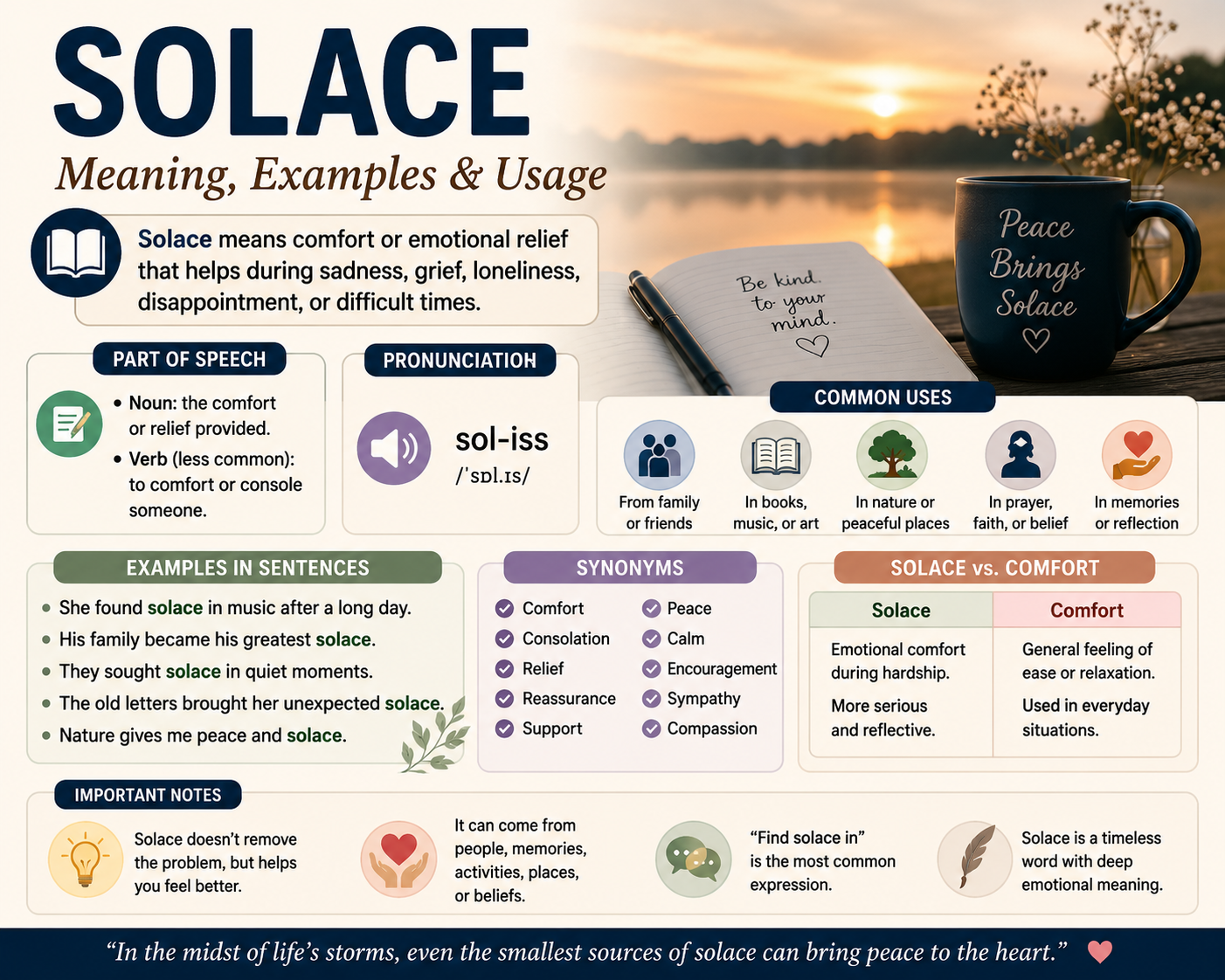
The simplest solace meaning is comfort or emotional relief during a difficult or painful experience.
When something gives you solace, it does not necessarily remove the problem. Instead, it helps you feel less upset, lonely, worried, or distressed. A person, memory, activity, place, belief, or even a small moment can provide solace.
For example:
“She found solace in music after a difficult week.”
This means that music gave her emotional comfort while she was going through a stressful period.
Solace is commonly associated with sadness, grief, disappointment, loneliness, and hardship. Major dictionaries describe it as comfort or help that makes emotional pain easier to bear.
Simple Definition of Solace
In everyday English, you can think of solace as:
- Comfort during sadness
- Relief from emotional pain
- Something that makes a difficult situation easier
- A source of peace during hardship
- Emotional support when life feels overwhelming
The word is usually more formal than “comfort.” You might say, “My friends gave me comfort,” in ordinary conversation. In more thoughtful or literary writing, you could say, “My friends became a source of solace.”
Solace Meaning in Simple Words
If the word sounds complicated, remember one simple idea: solace means something that makes you feel better when you are going through something difficult.
Imagine someone has lost an important relationship. Their sadness may not disappear quickly, but spending time with supportive friends might bring comfort. Those friends can become a source of solace.
Similarly, someone struggling with stress might find solace in:
- Listening to music
- Reading a favorite book
- Spending time in nature
- Talking with family
- Writing in a journal
- Praying or reflecting
- Remembering happy experiences
- Taking quiet time alone
The important point is that solace is connected to emotional comfort rather than ordinary physical convenience.
For instance, a comfortable chair is physically comfortable, but it would not normally be described as “solace” unless it provides emotional relief in a particular situation.
15 Short Examples of Solace in Everyday Language
- “She found solace in her family.”
- “Music became his solace.”
- “He sought solace after the disappointing news.”
- “Nature gave her a sense of solace.”
- “She found solace in old photographs.”
- “His friends offered solace during the difficult time.”
- “Writing became a source of solace.”
- “The quiet room provided some solace.”
- “She took solace in happy memories.”
- “He found solace in prayer.”
- “Books often provide solace.”
- “The friendship brought her great solace.”
- “He turned to art for solace.”
- “The peaceful garden offered solace.”
- “She found solace in knowing she was not alone.”
Solace Meaning in Text and Social Media

When people use the word solace in texts, captions, or social media posts, the basic meaning usually stays the same. It generally refers to finding comfort, peace, or emotional relief.
Unlike internet abbreviations such as “LOL,” “BRB,” or “NGL,” solace is not slang. It is a standard English vocabulary word. Its appearance on Instagram, TikTok, WhatsApp, Snapchat, or other platforms does not create a separate slang definition.
Someone might write:
“Finding solace in the little things.”
This means that small, meaningful experiences are providing comfort during a difficult period.
Another example is:
“I found solace in talking to you.”
Here, the person is saying that the conversation helped them feel emotionally supported.
15 Social Media Caption Ideas Using Solace
- “Finding solace in quiet mornings.”
- “A little peace, a little solace.”
- “Nature is my favorite source of solace.”
- “Finding solace between the pages of a book.”
- “Music brings me solace.”
- “Some memories become unexpected sources of solace.”
- “Choosing peace and finding solace.”
- “There is solace in slowing down.”
- “Finding solace in simple moments.”
- “Sometimes silence brings the deepest solace.”
- “Home will always be a source of solace.”
- “Finding solace beneath an open sky.”
- “Healing slowly, finding solace daily.”
- “Let the quiet moments bring solace.”
- “Peace feels like solace for the soul.”
Solace Meaning in English Grammar
Solace can function primarily as a noun, but it can also be used as a verb.
As a noun, solace means comfort or something that provides comfort.
Example:
“Her friends were a great solace during the crisis.”
Here, “solace” refers to the comfort provided by her friends.
As a verb, solace means to comfort or console someone who is experiencing sadness or distress.
Example:
“Her family solaced her after the loss.”
The verb form is less common in ordinary modern conversation and is often described as literary or formal.
Noun Form
The noun is the form you are most likely to encounter.
Common patterns include:
- Find solace
- Seek solace
- Take solace
- Offer solace
- Provide solace
- Bring solace
- Draw solace from something
- Find solace in something
Examples:
“He found solace in his work.”
“She sought solace from her closest friends.”
“They took solace in the good memories.”
Verb Form
The verb means to comfort someone.
Example:
“Her words solaced him during his grief.”
Although grammatically correct, “comforted” or “consoled” would usually sound more natural in everyday speech.
How to Use “Solace” in a Sentence
Understanding the solace meaning becomes much easier when you see common sentence patterns.
One of the most frequent structures is “find solace in.”
For example:
“She found solace in painting.”
This means painting helped her feel emotionally calmer or less distressed.
Another common structure is “seek solace.”
“He sought solace from his closest friends.”
This means he looked to his friends for emotional comfort.
You can also use “a source of solace.”
“Her grandmother became a source of solace during difficult years.”
The word often works particularly well when describing emotional experiences.
15 Sentence Examples
- “She found solace in music.”
- “He sought solace in his closest friends.”
- “The memories brought her solace.”
- “Reading became a source of solace.”
- “He found solace in nature.”
- “Her family offered solace during the difficult period.”
- “The peaceful surroundings provided solace.”
- “She took solace in knowing she had tried.”
- “He found unexpected solace in painting.”
- “Prayer gave him solace.”
- “The friendship became a source of solace.”
- “She sought solace in familiar places.”
- “The old letters offered unexpected solace.”
- “He found solace in helping others.”
- “The song brought her a moment of solace.”
Solace Meaning vs. Comfort, Consolation, and Relief
Several English words are close to solace meaning, but they are not always interchangeable.
| Word | Basic Meaning | Typical Use |
| Solace | Emotional comfort during hardship | Grief, sadness, loneliness |
| Comfort | Making someone feel better | Everyday emotional or physical situations |
| Consolation | Something that eases disappointment or sadness | Loss, failure, disappointment |
| Relief | Reduction of pain, stress, or worry | Physical or emotional problems |
| Peace | A calm or undisturbed state | Mind, emotions, surroundings |
| Support | Help given during difficulty | Relationships and challenging situations |
“Solace” has a particularly emotional and reflective tone.
For example, “Her friends gave her support” emphasizes help. “Her friends gave her comfort” emphasizes feeling better. “Her friends became her solace” emphasizes the emotional refuge she found through them.
15 Quick Comparisons
- Comfort: “Her words comforted me.”
- Solace: “Her words gave me solace.”
- Support: “Her friends supported her.”
- Consolation: “The award was some consolation.”
- Relief: “The good news brought relief.”
- Peace: “The garden gave him peace.”
- Solace: “The garden became his solace.”
- Comfort: Often more everyday.
- Solace: Often more emotional or literary.
- Consolation: Often connected to disappointment.
- Relief: Often suggests a burden becoming lighter.
- Support: Focuses on assistance.
- Peace: Focuses on calmness.
- Solace: Focuses on emotional comfort.
- All can overlap: Context determines the best word.
Solace Meaning and the Phrase “Find Solace In”
The phrase “find solace in” is one of the most common expressions involving the word.
It means to discover comfort or emotional relief through a person, activity, place, belief, memory, or experience.
Examples include:
“She found solace in her children.”
“He found solace in writing.”
“They found solace in their shared memories.”
“I find solace in nature.”
This expression is especially common in writing about grief, recovery, personal struggles, disappointment, and difficult life experiences.
15 Examples of “Find Solace In”
- Find solace in friendship.
- Find solace in family.
- Find solace in music.
- Find solace in books.
- Find solace in nature.
- Find solace in prayer.
- Find solace in memories.
- Find solace in creativity.
- Find solace in writing.
- Find solace in peaceful surroundings.
- Find solace in meaningful conversations.
- Find solace in helping others.
- Find solace in familiar routines.
- Find solace in personal reflection.
- Find solace in small everyday moments.
Is Solace a Positive Word?
Yes. Solace generally has a positive meaning because it describes comfort or relief during a difficult experience.
However, the word is often used in serious contexts. It may appear when discussing grief, loss, loneliness, disappointment, illness, or emotional hardship.
For example:
“She found solace in the memories of her childhood.”
The situation may be sad, but the solace itself is positive because those memories provide emotional comfort.
This distinction is important. Solace does not mean happiness itself. Instead, it describes something that helps a person cope with sadness or difficulty.
When Solace Is Appropriate
You can use the word when discussing:
- Grief
- Loss
- Heartbreak
- Stress
- Disappointment
- Loneliness
- Difficult memories
- Emotional recovery
- Personal struggles
- Spiritual comfort
The word can also be used more broadly when a person finds peace or reassurance in an activity.
Solace Meaning and Word Origin
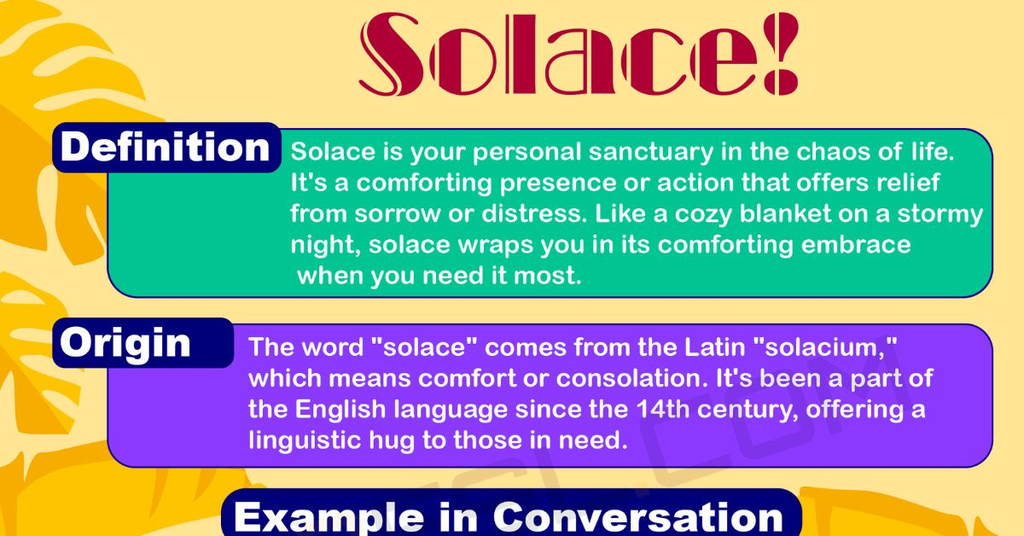
The history of solace goes back centuries. English dictionaries trace it through Middle English and Old French to Latin roots associated with comforting or consoling someone. Oxford connects the word with Old French forms and the Latin verb solari, meaning “to console.”
Dictionary.com gives the first recorded use as approximately 1250–1300 and also traces it through Middle English and Old French to Latin sōlācium.
This history helps explain why the modern word still carries a strong connection to consolation and emotional support.
Because of its long literary history, solace often sounds more formal than simpler words such as “comfort.”
Related Words
Some useful related words include:
- Comfort
- Consolation
- Relief
- Reassurance
- Support
- Peace
- Calm
- Sympathy
- Compassion
- Encouragement
- Soothe
- Console
Learning these related terms can help you understand the emotional range surrounding the word.
Solace Meaning in Literature and Emotional Writing
Solace is especially common in literature because it can describe complicated emotional experiences in a single word.
A character may experience grief while simultaneously finding solace in a memory, relationship, landscape, piece of music, or personal belief.
The word can therefore communicate both sadness and comfort at the same time.
For example:
“The old house became a place of solace.”
This sentence suggests that the house provides emotional comfort, perhaps because it reminds someone of happier times.
Writers may choose “solace” instead of “comfort” because it creates a more reflective or poetic tone.
15 Literary-Style Examples
- “She found solace beneath the old oak tree.”
- “His memories became a quiet solace.”
- “Music offered solace when words failed.”
- “The familiar room brought unexpected solace.”
- “She sought solace in the stillness of dawn.”
- “His letters remained a source of solace.”
- “The sea offered him a strange sense of solace.”
- “Her kindness became his greatest solace.”
- “He found solace in remembering better days.”
- “The garden provided solace after long days.”
- “Silence became a form of solace.”
- “The familiar melody brought solace.”
- “She discovered solace in creative work.”
- “Their friendship became her emotional solace.”
- “He carried that memory as a source of solace.”
Is Solace Slang?
No, solace is not slang.
It is a standard English word that has been used for centuries. It may appear in modern texts, captions, comments, and social media posts, but its definition does not change simply because it is being used online.
In texting, someone might write:
“This place gives me solace.”
They are simply using the standard meaning of the word.
If you see “solace” online, look at the surrounding sentence rather than assuming it has a hidden internet meaning.
The context usually tells you what is providing emotional comfort.
FAQs About Solace Meaning
What does solace mean in simple words?
Solace means comfort or emotional relief when you are sad, worried, disappointed, lonely, or going through a difficult experience.
What does solace mean in a sentence?
It describes a person, thing, activity, or experience that provides emotional comfort, such as “She found solace in music.”
Is solace a positive word?
Yes. Solace generally has a positive meaning because it refers to comfort or relief, although it is often discussed in serious or difficult situations.
Is solace a slang word?
No. Solace is a standard English vocabulary word, not internet slang or texting shorthand.
What does “find solace in” mean?
“Find solace in” means to discover emotional comfort through something or someone, such as family, music, nature, memories, or friendship.
What is the synonym of solace?
Common synonyms include comfort, consolation, relief, peace, support, reassurance, and consolation, depending on the context.
What does solace mean in texting?
In texting, solace normally has the same standard meaning: emotional comfort or relief during sadness, stress, grief, or difficulty.
How do you pronounce solace?
Solace is commonly pronounced roughly as “SOL-iss.” Pronunciation can vary slightly between British and American English.
Can a person be a solace?
Yes. A person can be described as a solace when their presence provides comfort or emotional support during a difficult time.
What is the difference between solace and comfort?
Comfort is the broader everyday term, while solace often has a more emotional, serious, or literary sense connected with sadness or hardship.
Conclusion
Understanding solace meaning is easier when you connect it with one central idea: emotional comfort during a difficult time. Solace can come from people, memories, music, nature, books, faith, creativity, or quiet personal moments. It is a standard English word rather than slang, and it often appears in formal, literary, emotional, and thoughtful writing. The most common expressions include “find solace in,” “seek solace,” and “a source of solace.” Although it is similar to comfort, consolation, peace, and relief, solace has a particularly reflective emotional quality. Once you understand that feeling of finding comfort while facing difficulty, the meaning and usage of solace become much easier to remember.
